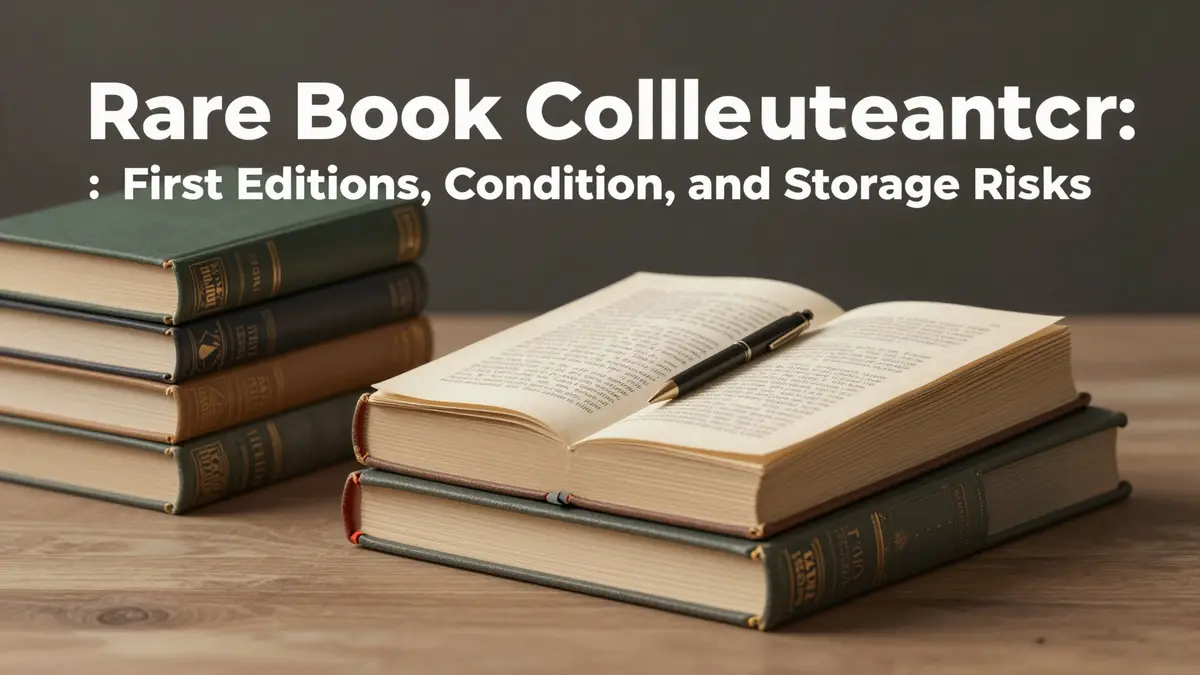
Conventional homeowners insurance policies typically exclude or severely limit coverage for high-value collectibles, often capping payouts for unscheduled personal property at low sublimits. For a collector of rare books, manuscripts, or historical ephemera, relying on an ordinary policy can lead to devastating financial losses. If a pipe bursts or a fire breaks out, a basic policy may treat a rare 17th-century folio as a common modern hardcover, leaving the owner with a payout that represents only a fraction of the item's true worth. To secure comprehensive protection, collectors must transition from standard actual cash value (ACV) coverage to scheduled personal property endorsements or specialized inland marine policies. This transition requires establishing an itemized catalog trail, obtaining USPAP-compliant appraisals, documenting first-edition points of issue, and maintaining strict climate-controlled storage to mitigate environmental and physical risks.
Why Standard Homeowners Insurance Fails to Cover Rare Book Losses
Conventional homeowners insurance policies are designed to protect typical household goods. Under these basic forms, personal property is usually assessed on an Actual Cash Value (ACV) basis. This method calculates the replacement cost of the item at the time of loss and then subtracts physical depreciation for age, wear, and obsolescence [SOURCE ID: NAIC-04]. Alternatively, some policies offer Replacement Cost Value (RCV). This option covers the cost to repair or replace the damaged property with new items of like kind and quality, without deducting for depreciation, up to the policy's coverage limits [SOURCE ID: NAIC-04].
For rare books, neither standard ACV nor standard RCV provides adequate protection. Because rare books often appreciate in value or derive their worth from historical scarcity, standard valuation methods fail to account for market appreciation without a scheduled endorsement or an Agreed Value policy [SOURCE ID: NAIC-04]. Under an Agreed Value endorsement, the insurer and the policyholder agree on the value of the item at the policy's inception, based on professional appraisals, and this agreed amount is paid in the event of a total covered loss.
It is important to note that standard policies treat unscheduled books as common household goods. Consequently, claims adjusters value them based on modern functional equivalents rather than historical or bibliographic scarcity. The table below outlines how different policy structures might treat a total loss scenario involving a high-value volume, assuming a hypothetical first edition, first printing of a 20th-century classic novel with an intact, un-restored dust jacket, valued at $15,000.
Hypothetical educational scenario (Actual thresholds, sublimits, and deductibles vary by carrier, state, and policy form):
Related Posts

| Policy Valuation Type | Theoretical Calculation Method | Potential Payout Limit | Primary Risk to Collector |
|---|---|---|---|
| Actual Cash Value (ACV) | Replacement cost of a modern reprint, minus physical depreciation for a 70-year-old paper object [SOURCE ID: NAIC-04]. | Negligible (often under $50) | Fails to recognize historical, bibliographic, or scarcity value. |
| Replacement Cost Value (RCV) | Cost to purchase a new, retail-grade copy of the same title (typically a modern hardcover reprint) [SOURCE ID: NAIC-04]. | Cost of a modern reprint ($30 - $50) | Does not replace the specific historical edition or printing state. |
| Scheduled Agreed Value | Pre-established appraisal value agreed upon by the carrier and collector prior to the loss [SOURCE ID: NAIC-04]. | Full scheduled amount ($15,000) | Requires regular appraisal updates to keep pace with market fluctuations. |
Step-by-Step Guide to Documenting and Insuring a Rare Book Collection

Transitioning a collection from standard personal property coverage to a specialized fine art or scheduled personal property policy requires a systematic approach to documentation and underwriting.
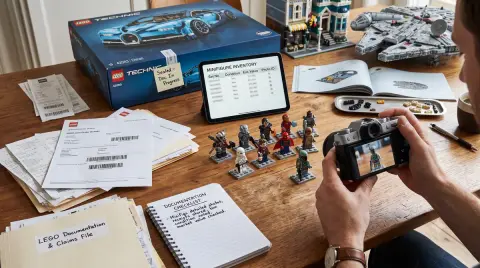
- Establish an Itemized Catalog Trail: Maintain a detailed inventory containing the essential bibliographic details of each volume. This includes the author, full title, publisher, place and date of publication, binding material (e.g., original cloth, contemporary calf, modern fine binding), and the presence or absence of the dust jacket, original slipcase, or specific bibliographic points of issue.
- Document First Edition Points of Issue: A "point of issue" is a specific typographical error, layout variation, or binding characteristic that distinguishes the earliest printing state from subsequent impressions. For example, a first printing might feature a misspelled word on a specific page that was corrected in the second printing. Photograph these specific pages, including the title page, copyright page (showing the printing history or number line), and any known point-of-issue pages, to verify the book's precise bibliographic state.
- Verify and Document Provenance and Signatures: For signed, inscribed, or association copies (books once owned by the author or a notable historical figure), document the provenance. Keep physical or digital copies of auction records, certificates of authenticity, sales receipts from reputable antiquarian booksellers, and historical ownership records. Photograph signatures alongside a scale or color reference card to assist in future verification.
- Grade the Dust Jacket and Physical Condition: In the modern first edition market, the dust jacket can represent 70% to 80% of the book's overall market value. Document the condition of both the book and the jacket using standard antiquarian grading terms (e.g., As New, Fine, Very Good, Good, Fair, Poor). Note any specific defects such as chipping, tearing, sun-fading, foxing, price-clipping, or professional restoration. Use archival-grade, acid-free polyester sleeves (such as Mylar) to protect jackets, and document this preservation measure for underwriters.
- Secure a USPAP-Compliant Appraisal: Insurers generally require a formal appraisal for high-value items (often those valued over $5,000 or $10,000, depending on carrier guidelines). Ensure the appraisal is conducted by a professional appraiser who adheres to the Uniform Standards of Professional Appraisal Practice (USPAP) and is a member of a recognized professional organization, such as the Antiquarian Booksellers' Association of America (ABAA), the Appraisers Association of America (AAA), or the International Society of Appraisers (ISA).
- Implement Environmental and Storage Controls: Underwriters evaluate physical risk factors when underwriting rare book collections. Store high-value volumes in a climate-controlled environment with a stable relative humidity (RH) between 45% and 55% and temperatures between 60°F and 65°F. Keep books away from direct sunlight or UV-emitting light sources to prevent paper embrittlement and spine fading. Elevate shelving at least four to six inches off the floor to mitigate localized water damage risks.
- Secure Digital Inventory Backups and Sanitize Retired Media: Store digital catalogs, high-resolution photographs, and appraisal certificates in a secure, redundant cloud environment. If you decommission or replace local storage drives, servers, or computers containing these sensitive financial records, appraisal documents, or high-value inventory lists, follow proper data security protocols. According to the National Institute of Standards and Technology (NIST), media sanitization should involve physical destruction or cryptographic erasure protocols to prevent unauthorized access to sensitive data, and collectors or their IT representatives should maintain verification logs of the sanitized storage components [SOURCE ID: NIST-01].
Common Collection Vulnerabilities and Mitigation Strategies
Rare books are highly susceptible to environmental degradation and physical hazards. Understanding how these risks impact both the physical preservation of the collection and the corresponding insurance coverage is critical for risk management.
| Vulnerability / Symptom | Root Cause | Preservation & Insurance Mitigation Strategy |
|---|---|---|
| Foxing and Mold Growth | High relative humidity (above 60%) and poor air circulation, causing fungal growth and chemical reactions in acidic paper. | Install dehumidifiers and continuous monitoring hygrometers. Standard policies often exclude mold damage unless it directly results from a covered water peril; verify if your policy has a mold limitation or exclusion. |
| Spine Fading and Paper Embrittlement | Exposure to ultraviolet (UV) light from windows or fluorescent lighting. | Apply UV-filtering films to windows, use LED lighting with zero UV emission, and keep high-value volumes in custom-made, acid-free slipcases or clamshell boxes (solander boxes). |
| Water Damage (Swell and Warping) | Leaking pipes, roof failures, or localized flooding. | Never store rare books in basements or directly under water pipes. Install water-detection sensors linked to a monitored alarm system. Ensure the policy covers water damage from internal plumbing failures. |
| Smoke and Soot Deposition | Nearby fire or poorly maintained heating systems. | Install a monitored smoke detection system. In the event of smoke exposure, avoid wiping the surfaces, as this can grind soot into the paper fibers; instead, contact a professional conservator and notify your insurer immediately. |
Actionable Checklist: Preparing Your Collection for Underwriting
- Inventory Verification: Ensure every book valued above the policy's unscheduled limit has a corresponding record detailing author, title, date, edition, and condition.
- Photographic Evidence: Take clear, high-resolution photographs of the front cover, spine, title page, copyright page, and any notable defects or signatures.
- Appraisal Currency: Verify that all professional appraisals are USPAP-compliant and have been updated within the last three to five years, depending on market volatility.
- Storage Assessment: Confirm that books are stored on metal or sealed wood shelving (unsealed wood can release harmful volatile organic compounds) elevated off the floor.
- Policy Review: Check your policy for specific exclusions, such as "wear and tear," "gradual deterioration," "vermin," or "humidity extremes," which are standard in many property forms.
- Backup Security: Store a copy of your inventory off-site or in a secure cloud environment, ensuring any retired local drives containing these records are sanitized according to NIST guidelines [SOURCE ID: NIST-01].
Tax Implications of Unreimbursed Losses
In